
Middletown Quality Gutters provides gutter cleaning in Middletown Township, NJ, serving surrounding cities including Red Bank, Holmdel, Eatontown, Aberdeen and Tinton Falls. We have cleaned, repaired and replaced gutters for more than 20 years, so a cleaning visit with us is also a close look at the whole drainage system. We clear the troughs by hand, flush every downspout and leave nothing behind on the lawn.
A gutter that looks clean from the ground can still be blocked where it matters. Leaves pack into elbows and downspout bends, shingle grit settles at the outlets, and a buried leader can fill with silt. Our visits do not stop at the trough, because a clean gutter draining into a clogged downspout still overflows in the first hard rain.
Every visit ends with before-and-after photos, so you can see what was in your gutters and what they look like now without climbing a ladder. If we spot a loose hanger, a leaking corner or soft fascia, the photos show that too. You get a clear picture of the gutters along with clean ones.
Residential and Commercial Gutter Cleaning
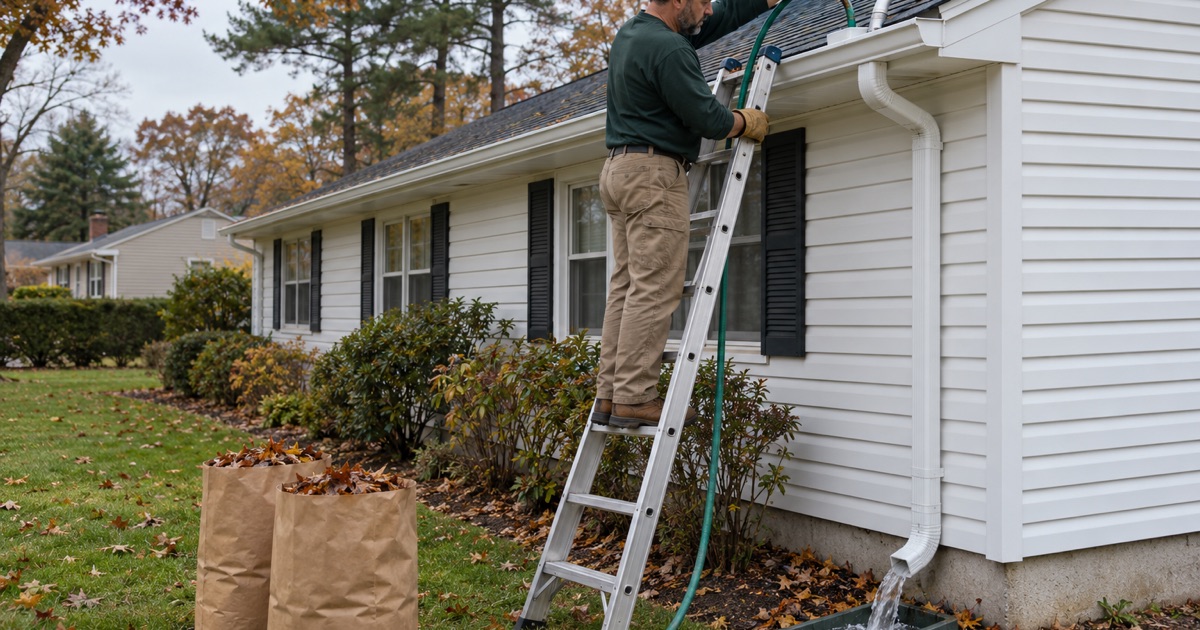
Gutter Cleaning for Houses
Most of our cleanings are on single-family homes, from one-story ranches to tall colonials where the gutters sit well above a safe homeowner ladder. Two-story cleaning is the work people most often hand off, and it is where a fall is most likely. We bring the ladders, standoffs and roof equipment needed to reach every run safely.
We work around landscaping, decks and outdoor furniture, and we protect plantings below the gutters while we work. On houses with steep or complex roofs, we plan the route before starting so no section is skipped. Each cleaning ends with a walk around the house to confirm every downspout is running clear.
Condominiums and Townhouse Communities
In a condominium or townhouse community, the master deed decides whether gutter cleaning is the association’s job or each owner’s. We check with the management office before scheduling, so owners and boards both know who is paying. Then we can clean a single unit or an entire building.
For associations, we schedule cleanings section by section and photograph each unit’s gutters before and after. Those photos give the board a record of the work and a list of any repairs found. Recurring schedules keep the whole community on the same calendar each fall.
Commercial and Multifamily Buildings
Offices, retail buildings, churches and apartment properties carry larger gutters, box gutters and long downspout runs that move a lot of water. Clogged commercial gutters can overflow at entrances and walkways, where water and ice become a safety problem. We clean these systems on a schedule that fits around tenants and business hours.
Commercial roofs often drain through scuppers and collector boxes as well as eave gutters. We clear those along with the gutters and check that the leaders below them run freely. Property managers receive photos and notes for each building after every visit.
What Every Gutter Cleaning Visit Includes
Clearing the Troughs and Bagging the Debris
We remove leaves, needles, seeds, nests and sludge from every gutter by hand, working the full length of each run. Blowing debris out of a gutter scatters it across the roof, siding and yard, so we scoop it instead. Everything goes into bags that leave with us.
Nothing is dumped in the flower beds or left at the curb for trash day. When we finish, we rinse any splatter off nearby siding, windows and walkways. The aim is that the only sign we were there is gutters that work.
Flushing Every Downspout
Once the troughs are clear, we run water into each outlet and watch it come out at the bottom. Downspouts most often clog at the elbows, where the pipe turns at the eave and again at the ground. We clear any blockage we find and run the water again until it flows freely.
Where a downspout feeds an underground line, we check that water reaches the far end, whether that is a pop-up emitter, a curb outlet or a drywell. A buried line that backs up sends water straight to the foundation. If we cannot clear it during the visit, we tell you and photograph the problem.
Checking Pitch, Joints and Hangers
A cleaning is the best chance to look at the gutter itself. With the trough empty, standing water shows where the pitch has gone flat, and stains show where corners and end caps are leaking. Loose or bent hangers are easy to spot along a clean run.
We note every problem in the photos and explain what it means. Small fixes, such as resealing a joint with tripolymer gutter sealant or resetting a loose hanger, can often be done during the visit with your approval. Anything larger is quoted separately.
Before-and-After Photos
Every cleaning comes with before-and-after photos of the gutters. Owners who are away during the visit can see exactly what was done, and landlords and property managers get a record for their files. The photos also make it easy to compare the condition of the gutters from year to year.
When we find damage, the photos show where it is and how bad it looks. That is useful for planning repairs and for any conversation with an insurer after a storm. We send them to you as soon as the visit is finished.
When and How Often to Clean Gutters
Late-Fall Cleaning After the Leaves Drop
For most houses under deciduous trees, the most important cleaning is in late fall, after oaks and maples have finished dropping their leaves. Cleaning too early leaves the gutters to fill again before winter. We schedule fall visits around when the trees on your lot actually finish.
A clean gutter going into winter matters because a packed trough holds water that freezes. Ice adds weight to the hangers and can push water back under the roof edge. Clearing the leaves before the first hard freeze avoids both problems.
Spring Cleaning for Seeds, Pods and Grit
Spring brings maple seeds, oak catkins, pollen and the shingle grit that washed off the roof over winter. That material settles at the bottom of the gutter and around the outlets, where it can block a downspout before summer storms arrive. Seeds left in a damp gutter can also sprout.
Many owners add a spring visit, especially those with large trees close to the house. It is also a good time to check for winter damage, such as hangers bent by ice or seams opened by freezing. We look at both during the same visit.
Houses Under Pines and Large Oaks
Pine needles fall throughout the year rather than in one season, and they mat inside a gutter into a dense, water-holding layer. Houses under pines often need cleaning more than once or twice a year to keep water moving. Large oaks add acorns, caps and catkins on top of their leaves.
For these houses, we recommend a schedule based on what actually collects in the gutters. If the cleanings become frequent, we can also show you the guard options suited to those trees. A stainless micro-mesh guard is usually the answer under pines.
Cleaning After a Storm
A strong windstorm can strip twigs, leaves and branches into the gutters in a single afternoon. If gutters overflow in the next rain or a branch has landed on the roof, an extra cleaning is worth scheduling. We also check for bent or detached sections while we are up there.
Middletown’s own flood guidance asks residents to keep gutters, downspouts and splash pads clean so rainwater flows away from the house. That advice matters most after storms, when gutters and leaders are most likely to be blocked. Clearing them quickly keeps the next downpour away from the foundation.
What We Often Find During a Gutter Cleaning
Standing Water and Sagging Runs
Standing water in a freshly cleaned gutter means a section has lost its pitch, usually because hangers have loosened or the fascia behind them has softened. Water left sitting in a gutter adds weight, breeds mosquitoes and speeds corrosion at the seams. We mark the low spots and photograph them.
Resetting a few hangers can restore the pitch on a short section. On a long run with many failed spikes, rehanging the gutter on hidden hangers is the better fix. We explain both and quote the repair separately from the cleaning.
Nests, Plants and Mosquitoes
Gutters that hold wet debris become planters and nesting ledges. We often find seedlings, moss and bird or wasp nests during cleanings, especially on shaded sections. Wherever water stands, mosquitoes can breed through the summer.
We remove nests and plant growth along with the rest of the debris. If a nest is active, we tell you before disturbing it. Fixing the pitch so the gutter drains dry between storms is what keeps these problems from coming back.
Water Landing Against the Foundation
When we flush the downspouts, we see where the water goes. Too often it pours out a short elbow right beside the foundation, or into a flower bed that slopes toward the house. That water is a common cause of wet basements after storms.
When a downspout lets out too close, we note it and recommend an extension, a pop-up emitter on an underground line, or a drywell where the soil and lot allow. Those options are quoted separately. The cleaning visit is often where owners first learn where their roof water actually goes.
- 20+ Years on Gutters
- Seamless, Formed On Site
- Before-and-After Photos