
Middletown Quality Gutters handles gutter replacement in Middletown Township, NJ, serving surrounding cities including Red Bank, Holmdel, Eatontown, Aberdeen and Tinton Falls. After more than 20 years of tearing off old gutters, we know what tends to be hiding behind them and what usually went wrong the first time. A replacement is the chance to fix those mistakes, not repeat them.
Many of the gutters we replace were installed decades ago in short joined sections, hung on spikes and sized by habit. They leak at the seams, lean away from the house and spill over in hard rain. Replacing them in kind would give you new metal with the same old problems.
So we treat every replacement as a redesign. We measure the roof that drains to each run, rethink where the downspouts go and where their water ends up, and inspect the fascia once the old gutters are down. You get seamless gutters sized for your house, hung on solid wood, with a drainage plan you can see on the estimate.
Signs Your Gutters Need Replacing
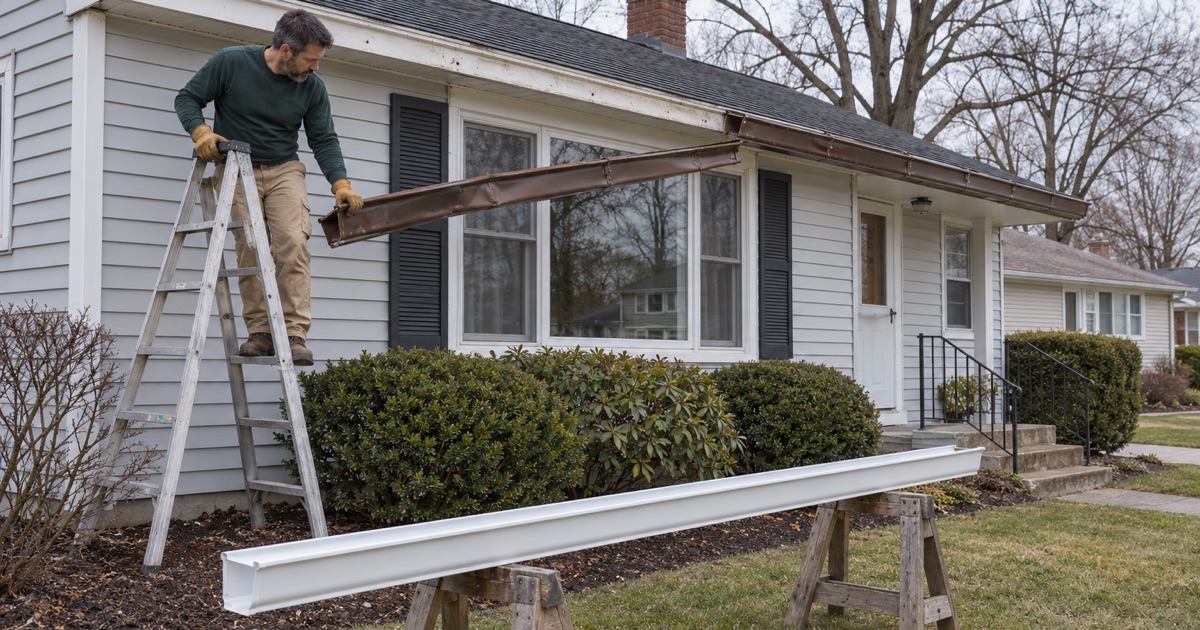
Leaks at Many Seams
One leaking corner is a repair. When drips show up at joint after joint along a sectional gutter, the sealant has reached the end of its life across the whole system. Resealing it piece by piece buys a season or two before the next joint lets go.
Those leaks do damage while they wait. Each one soaks the fascia and soffit below, stains the siding and wets the ground beside the foundation. When we see that pattern, replacing the system with seamless gutters is usually cheaper over time than chasing every joint.
Gutters Sagging Along Their Length
A gutter that sags in one spot can be rehung. One that dips and leans along its entire length, with spikes backing out of the fascia at every hanger, has lost its grip on the house. The low spots hold water and debris, which adds weight and makes the sag worse every winter.
Often the fascia behind a sagging system has softened from years of overflow. Rehanging old gutters on rotting wood only works until the next storm. Replacement lets us repair the wood and start over with hidden hangers screwed into sound boards.
Gutters Too Small for the Roof
If your gutters overflow during every hard storm even when they are clean, they are probably undersized for the roof that drains into them. That is common on two-story houses with long, steep slopes that were fitted with the same 5-inch gutters and small downspouts as a ranch house. No amount of cleaning makes a small gutter carry more water.
Replacement is the moment to fix the size. We measure each roof area and its pitch and choose 5-inch or 6-inch K-style gutters with 3x4 downspouts where the roof calls for them. Adding outlets on long runs can matter just as much as the gutter width.
Rust, Corrosion and Peeling Finish
Galvanized steel gutters rust from the inside out, often showing orange streaks or pinholes before they fail. Aluminum gutters do not rust, but their painted finish can chalk, peel and fade with age. Near salt water, metal and fasteners corrode faster than they do inland.
Corrosion that has eaten through the trough cannot be patched reliably. When we see rust holes along the bottom of a steel gutter or widespread pitting in old aluminum, we recommend replacement. A new prefinished aluminum or copper system resolves both the leaks and the appearance.
What Changes When We Replace Old Gutters
From Sectional to Seamless
Most of the old gutters we remove were assembled from short factory lengths joined every several feet. We replace them with seamless gutters rolled from .032 aluminum coil at the house, one continuous piece for each run. That removes the joints that caused most of the leaks.
The only seams left in a seamless system are the corners, end caps and outlets. Those are riveted and sealed with tripolymer sealant, which stays flexible through heat and cold. The result is fewer leak points and a cleaner line along the roof edge.
Moving Downspouts and Rethinking Discharge
Old downspouts are often in the wrong places: too few for the roof, tucked behind a shrub, or emptying straight onto a walkway or beside the foundation. Because a replacement starts with a blank roof edge, we can put outlets where they drain best. Wide-flange outlets help water enter the downspout quickly.
We follow each new downspout to where its water will land. Where that is too close to the house, we propose an extension, an underground line to a pop-up emitter or a drywell. We never tie a leader into the sanitary sewer, and every discharge point is named on the estimate.
Fascia and Roof-Edge Flashing
Removing the old gutters exposes the fascia boards they hung on. We probe every board for rot, show you any soft wood before replacing it, and repair it so the new hangers have solid material to grip. On painted trim of houses built before 1978, we follow the EPA lead-safe work practice rule.
The roof edge is open at the same time, which makes it the best moment to add a missing gutter apron or drip edge. Where a roof meets a sidewall, we add kickout flashing if it is absent. These details stop water from running behind the new gutters and repeating the damage.
Hidden Hangers Instead of Spikes
Older gutters were usually hung with long spikes driven through ferrules into the fascia. Wood swelling and shrinking pushes those spikes out over time, which is why so many old gutters lean away from the house. We hang replacement gutters on hidden hangers screwed into the fascia at close spacing.
The hangers brace the gutter from inside, stiffening it against the weight of snow, ice and wet leaves. Screws keep their grip where spikes loosen. Combined with heavier .032 coil, that keeps the new gutter straight and pitched for its full service life.
Gutter Replacement on Special Houses
Bayshore Houses and Salt Air
Houses near Raritan Bay and Sandy Hook Bay take a beating from salt air, which corrodes metal finishes and fasteners faster than it does inland. Some gutter and coil manufacturers restrict their warranties near salt water. We read those terms before choosing materials so the replacement keeps its coverage.
That can mean a particular coil finish, stainless or coated fasteners, or copper on some houses. We explain the options and how each holds up near the water. The goal is a replacement that does not fail early just because the house is close to the bay.
Raised Houses in the Flood Zone
About 350 Middletown homes had to be elevated or rebuilt after Hurricane Sandy, and a raised house needs gutters and downspouts planned for its new height. Downspout drops are longer, the ground below has changed, and water must clear the foundation piers. We lay out the system for the house as it now stands.
In the flood zone, Middletown tracks the cost of permitted work on a house over 10 years toward the 50 percent substantial improvement test, and FEMA P-758 lists gutters and downspouts among the counted costs. We provide itemized estimates that serve that review. Owners can then see how the gutter work fits within the larger picture.
Historic Houses and Copper
On a house in one of Middletown’s historic districts, such as Middletown Village, Navesink, Locust, Chapel Hill or Monmouth Hills, exterior work goes before the Landmarks Commission. Replacing old gutters with a modern K-style profile can change the look of the house. Half-round and copper gutters are often the closer match.
We match copper and half-round replacements to the age and style of the house, using 16-ounce copper with round downspouts where it fits. New copper weathers to a natural patina over the years. We can provide the profile and material details the commission asks for.
Condominiums and Townhouses
In a condominium or townhouse community, the master deed decides who owns the gutters and who pays to replace them. We check the deed or ask the management office before quoting. That way an owner does not pay for a replacement the association is responsible for.
When an association replaces gutters across a building or community, we match profiles, colors and downspout layouts across every unit. We schedule the work by building and photograph each unit for the board’s records. Consistent replacement keeps the community looking uniform.
Cost, Tax and Contracts
What Gutter Replacement Costs
The price of a replacement depends mostly on the total length of eaves, the number of stories, the number of downspouts and whether fascia repair or guards are added. Published Monmouth County contractor pricing puts a typical home between $1,200 and $4,500, with installed aluminum at roughly $7 to $13 per linear foot and copper at $20 to $40. Tear-off of the old gutters is part of the job.
We measure the house and give you a fixed written price before scheduling anything. If we find rotted fascia once the old gutters are down, we show you and price it before replacing it. You decide on any added work with the facts in front of you.
Sales Tax, Permits and Your Contract
New Jersey treats new gutters as a capital improvement, exempt from sales tax when the owner signs Form ST-8, while repairs are taxable. Our estimates list replacement and repair on separate lines so each is taxed correctly. The state construction code treats gutter and leader replacement as ordinary maintenance, so the gutters themselves do not normally need a permit.
Gutter replacement is home improvement work under New Jersey’s contractor registration law, and you have three business days after signing to cancel the contract. Our written contract lists the gutter size, material, downspout locations, discharge points and price. Read it, ask questions and sign only when it describes the job you want.
- 20+ Years on Gutters
- Seamless, Formed On Site
- Before-and-After Photos