
Middletown Quality Gutters handles gutter repair in Middletown Township, NJ, serving surrounding cities including Red Bank, Holmdel, Eatontown, Aberdeen and Tinton Falls. Over more than 20 years we have fixed every kind of gutter failure, from a single dripping corner to a whole run peeling off a rotted fascia. Our job is to find out why the gutter failed, not just to patch the spot where it shows.
Most gutter problems are visible from the ground as symptoms: water spilling over the front, a stain on the siding, a gutter leaning out from the house or a puddle by the foundation. The cause is often somewhere else, like a clogged elbow, a hanger pulled out of soft wood or a downspout emptying in the wrong place. We trace each symptom back to its source before recommending a repair.
Every repair comes with before-and-after photos so you can see what we fixed without climbing a ladder. If we find soft fascia, we show it to you before replacing anything. When repair stops making sense and replacement would cost less over time, we tell you that plainly.
Common Gutter Repairs We Make
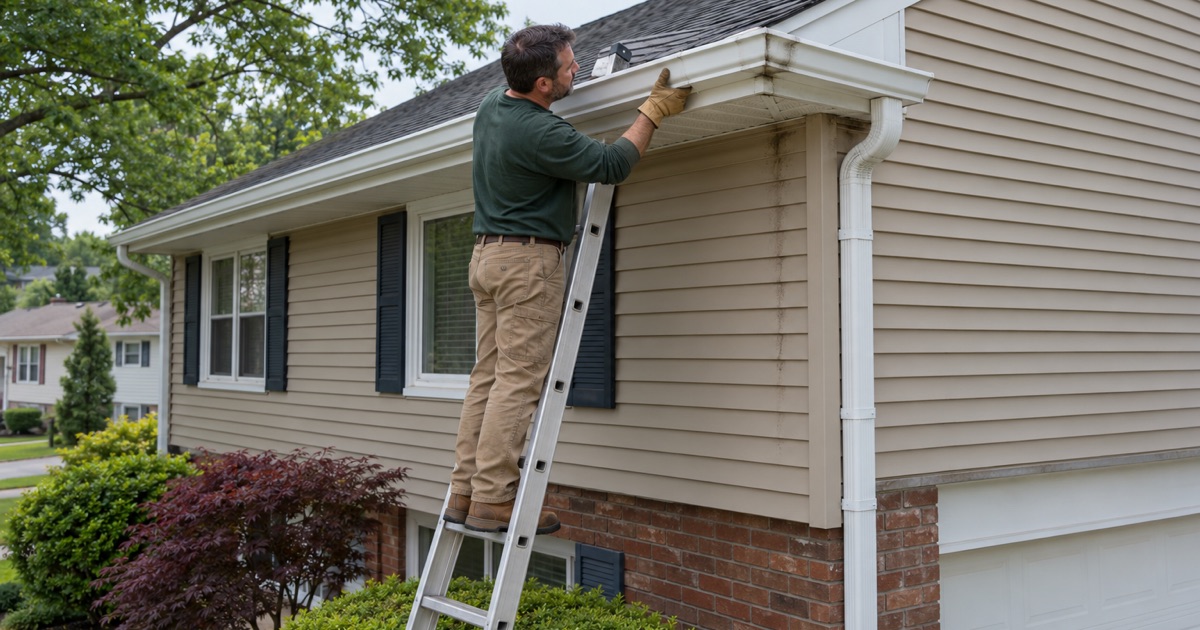
Resealing Leaking Seams, Corners and End Caps
Corners, end caps and outlets are the joints on a seamless gutter, and on a sectional gutter there are joints every few feet as well. The sealant at those joints dries out, cracks and lets go as the metal expands and contracts through the seasons. A drip that starts small can soak the fascia below for years before anyone notices the rot.
We clean each leaking joint down to bare metal, tighten it with new rivets where needed, and reseal it with tripolymer gutter sealant, which stays flexible as the gutter moves. Box, strip and bay miters each get the treatment that suits their shape. Where a sectional gutter leaks at many joints, we tell you replacement may be the better spend.
Rehanging Sagging Gutters
A gutter that sags or pulls away from the house has lost its grip on the fascia. On older systems, the cause is usually spikes that have backed out of the wood through years of freezing, thawing and the weight of wet leaves and snow. A sagging gutter holds water in the low spot, which adds weight and makes the sag worse.
We remove the failed spikes and ferrules and rehang the gutter on hidden hangers screwed into sound fascia. Then we reset the pitch so the run drains fully to its outlets. If the wood behind the gutter has softened, we repair it first, because new hangers will not hold in rotten fascia.
Fixing Gutters That Overflow
When water spills over the front of a gutter in heavy rain, the cause is a clog, a gutter too small for its roof area, too few downspouts or a section pitched the wrong way. Each needs a different fix. We look at where and when the gutter spills before deciding which it is.
A clogged elbow or outlet is cleared on the spot. A run that is undersized for a long, steep roof may need an added downspout to split the load, or a larger gutter. A section pitched away from its outlet is rehung to drain the right direction.
Stopping Water Behind the Gutter
Water running down the fascia behind a gutter usually means the roof edge has no gutter apron or drip edge directing water into the trough. It can also mean the gutter was hung too low, leaving a gap between the shingle edge and the back of the gutter. Either way, water soaks the fascia and soffit and stains the siding.
We add the missing flashing under the shingle edge so water drops into the gutter, or rehang the gutter at the right height. Where a roof meets a sidewall, we also check for a kickout flashing, since its absence sends water down the wall. These fixes are small compared with replacing rotted wood later.
Storm Damage and Dented Gutters
Wind, falling branches, ladders and ice slides can dent, bend or tear gutters loose. A deep dent can create a low spot that holds water, and a section torn from its hangers can pull the next one with it. We straighten what can be saved and replace what cannot, matching the profile and color.
Homeowners policies generally cover gutter damage from covered perils such as windstorms, lightning or falling branches, but not wear or age. When a storm is the cause, we photograph the damage and give you an itemized estimate to submit with your claim. The repair itself follows the same standard either way.
Downspout and Drainage Repairs
Clogged and Crushed Downspouts
Downspouts clog most often at the elbows, where leaves, needles and shingle grit catch at the bends. A clogged downspout backs water up into the gutter, which then overflows even if the trough itself is clean. Crushed downspouts, often hit by mowers or cars, choke the flow the same way.
We clear blockages by flushing from the top or opening the elbows, and we replace crushed sections and damaged A and B elbows with matching parts. Loose downspout straps are reset so the pipe stays tight to the wall. Every repaired downspout is tested with running water before we leave.
Underground Downspout Lines That Back Up
When water bubbles up out of the connection where a downspout enters the ground, the buried line is blocked, broken or ends nowhere useful. Roots, silt and leaves are the usual culprits, and old corrugated pipe crushes or sags with time. A backed-up line sends the whole roof’s water straight to the foundation.
We flush and test the line first. If it cannot be cleared, we dig it up and replace it with smooth-wall pipe running to a pop-up emitter or a properly placed drywell. We never connect a downspout to the sanitary sewer, and we tell you exactly where the new line will discharge.
Downspouts Emptying Against the Foundation
A downspout that lets out right beside the house dumps the water from a whole section of roof against the foundation in a heavy storm. That is one of the most common causes of wet basements we see. Short elbows, missing splash blocks and extensions knocked loose by mowers all lead to the same place.
The New Jersey edition of the 2021 International Residential Code, section R401.3, calls for the ground to fall 6 inches within the first 10 feet from the foundation. We follow each downspout to its outlet and, where water lands too close, add an extension, an underground line to a pop-up emitter, or a drywell. Each option is priced so you can choose.
Fascia and Roof-Edge Repairs
Replacing Rotted Fascia
The fascia board behind a gutter takes the brunt of every leak and overflow. Once it softens, gutter hangers pull out and the problem grows. Rot often hides behind the gutter, so it is only found when the gutter comes down.
We remove the affected gutter section, probe the board and show you any soft wood before replacing it. New fascia is cut to match, primed or wrapped, and the gutter is rehung on hidden hangers. On houses built before 1978, we follow the EPA lead-safe work practice rule whenever the repair disturbs painted trim.
Adding Drip Edge and Kickout Flashing
Many older roofs were built without drip edge or a gutter apron, the metal strips that carry water from the shingles into the gutter. Without them, water curls back under the roof edge and rots the fascia and roof deck. Adding them is one of the most effective gutter repairs we make.
Kickout flashing does the same job where a lower roof meets a sidewall, turning water into the gutter instead of down the wall. Missing kickouts can cause hidden rot inside walls. We check for both on every repair visit and add them where needed.
Repair or Replace?
When Repair Makes Sense
Repair is the right choice when the gutters are the right size for the roof, the metal is sound and the problems are limited to a few joints, a sagging section or a damaged downspout. Fixing those costs far less than a new system and can add years of service. We would rather repair a sound gutter than sell a new one.
Copper gutters in particular are often worth repairing. The metal can last for generations, and a resoldered seam or a replaced section can bring an old system back to full service. On half-round and copper work, we match the profile so the repair blends in.
When Replacement Is the Better Spend
When a sectional gutter leaks at many joints, sags along its whole length, or is too small for the roof it serves, repairs only delay the inevitable. Repeated service calls on a failing system add up quickly. A new seamless gutter sized to the roof often costs less over a few years than continual patching.
We give you both prices when the choice is close. Repair and replacement work appear on separate lines because New Jersey taxes repairs but treats new gutters as an exempt capital improvement. That way the decision is based on the full cost of each option.
Gutter Repairs Before a Home Sale
New Jersey home inspectors are required to inspect and report deficiencies in the roof drainage system, so leaking or sagging gutters often show up on a buyer’s report. We can inspect the flagged items, repair them and provide photos for the file. Fixing them before listing removes an easy negotiating point.
Middletown also requires its own certificate-of-occupancy inspection before every resale and rental, run under the International Property Maintenance Code. Gutters are not a named line item on that checklist, but its list is not all-inclusive and a roof leak is. Making sure the gutters are tight and draining is a sensible part of preparing a house for that inspection.
- 20+ Years on Gutters
- Seamless, Formed On Site
- Before-and-After Photos